
文部科学省 科学研究費補助金 学術変革領域研究 (A) 2023〜2027年度
FY2023-2027 MEXT KAKENHI Grant-in-Aid for Transformative Research Area (A)
A03
ECMとの相互作用で駆動される細胞集団運動メカニズム
Mathematical Modeling of Collective Cell Motion with Cell–ECM Interactions

石原 秀至 (東京大学 大学院総合文化研究科, 准教授)
Shuji Ishihara (UTokyo)
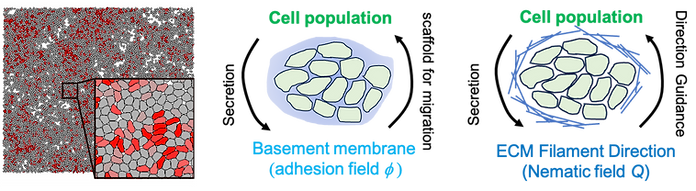
細胞外マトリックス(ECM)は細胞層に足場を与え,細胞や細胞集団の運動,組織形成に重要な役割を果たす.本研究では,ECMと細胞の協働的相互作用により生じる細胞集団運動の機構を,理論モデルにより明らかにする.細胞が示す集団運動は,発生やがん浸潤にも重要であり,多くの研究がなされてきたが,多くの研究では平坦な基質を細胞が這向して移動する運動を考えており,ECMとの協働的な相互作用があって初めて可能となる細胞集団運動,ECMがガイドする細胞運動の研究はよくわかっていない. 我々は変形できる細胞集団を効率よくシミュレートできる数値アルゴリズムを開発しており(Saito and Ishihara, Sci. Adv. 2024),これにECMとの相互作用を組み込んだ数理フレームワークを構築・発展させることで,ECMとの細胞の協働性により引き起こされる細胞集団運動モードを明らかにする.ECMと細胞の接着や硬さ勾配,ファイバー配向によって引き起こされる細胞集団運動はさまざまな実験系で見られ,理論的観点からそのメカニズムを同定し,制御や抑制へと繋げる.
The extracellular matrix (ECM) provides a scaffold for cell layers and plays an important role in the motion of cells and cell populations. Collective cell motion driven by cell–ECM adhesion, stiffness gradients, and fiber orientation has been observed in various experimental systems, yet its underlying mechanisms remain poorly understood, especially when motion is enabled by cooperative interactions with the ECM. In this study, we aim to elucidate the mechanisms of ECM-guided collective cell motion using theoretical modeling. Building on our numerical algorithm for simulating deformable cell populations (Saito and Ishihara, Sci. Adv. 2024), we will develop an efficient and flexible mathematical framework that incorporates cell–ECM interactions. This framework will be used to identify modes of collective cell motion induced by cell–ECM cooperativity and to provide theoretical insights into their control or suppression.