
文部科学省 科学研究費補助金 学術変革領域研究 (A) 2023〜2027年度
FY2023-2027 MEXT KAKENHI Grant-in-Aid for Transformative Research Area (A)
A02
培養環境の空間制御による神経管閉鎖プロセスの再現
Replicating Neural Tube Closure Process using Organoid by Spatial Control of Culture Environment

萩原 将也
(理化学研究所 生命機能科学研究センター, チームディレクター)
Masaya Hagiwara (RIKEN)
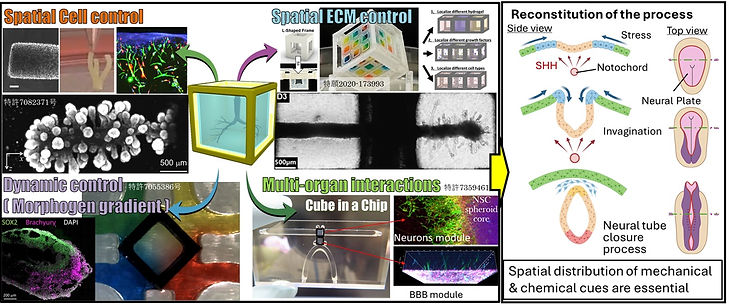
オルガノイド形成技術の発展に伴い,マイクロ流体チップによる分化因子シグナル勾配の形成や,2つの領域それぞれのオルガノイドを融合させるアセンブロイド技術が用いられ,臓器が持つ領域ごとの分化局在を有した新たなミニ臓器の構築が達成されている.しかし,いずれの研究も最終的な分化局在にのみ焦点を当て,発生プロセスそのものについては依然軽視されている.例えば神経管の発生過程において,固有の形状を持った細胞シートが,硬さや成分の違うECMの分布に応じて応力場が形成され,陥入が発生することを考えれば,発生プロセスを模倣するためにはマイクロ流体チップで因子シグナル勾配を与えるのみの実験系では不十分であり,ECMや細胞も含めた場の空間情報を適切に与えることが必要不可欠である.
一方,我々はこれまでにCUBE型の培養器をオルガノイドのキャリアとし,細胞周りおけるECMの局在制御,細胞集団形状の制御および流体チップとの統合による液性因子勾配制御技術を確立してきた.本研究課題では,in vitroの場においてECM・細胞・液性因子の空間情報を制御可能なプラットフォームを開発し,神経管閉鎖プロセスを模倣することを目的とする.
With the advancement of organoid formation technologies, approaches such as generating morphogen gradients using microfluidic chips and assembloids by fusing region-specific organoids have enabled the construction of novel mini-organs exhibiting spatially localized differentiation patterns. However, most of these studies focus primarily on the final differentiated states, while the developmental processes themselves remain largely overlooked. For example, during neural tube development, a cell sheet with an intrinsic geometry experiences stress fields formed in response to spatial variations in the stiffness and composition of the extracellular matrix (ECM), leading to invagination. Considering this, simply providing morphogen gradients via microfluidic systems is insufficient to faithfully recapitulate developmental processes. It is essential to properly reconstruct the spatial context of the microenvironment, including ECM distribution and cellular organization.
In contrast, we have previously developed a CUBE-based culture platform that serves as an organoid carrier, enabling precise control of ECM localization around cells, regulation of cell aggregate geometry, and integration with microfluidic systems for controlling soluble factor gradients. In this project, we aim to develop an in vitro platform capable of controlling the spatial information of ECM, cells, and soluble factors, and to recapitulate the neural tube closure process.